
When selecting a Current Transformer (CT) supplier, price is often one of the first things panel builders and electrical contractors compare. But for critical electrical systems, the lowest quotation does not necessarily represent the best value.
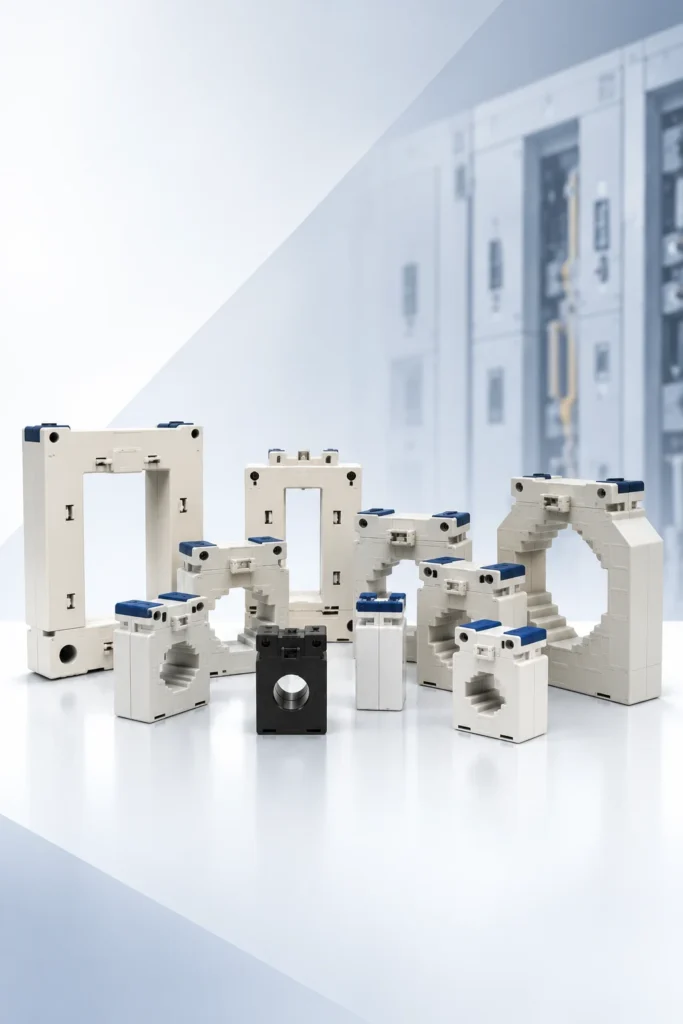
A current transformer is not simply a component that converts high current into a measurable secondary current. It is an important part of the measurement, protection, monitoring, and control system inside electrical switchgear.
For panel builders, choosing the right CT supplier means looking beyond the product price and evaluating accuracy, consistency, technical specifications, availability, documentation, and long-term supplier support.
Here are the factors that actually matter.
1. Start With the Application, Not the Price
The first question should not be “How much does the CT cost?”
It should be:
“What does the CT need to do?”
Current transformers can be used for several applications, including:
Energy and power measurement
Ammeter and meter applications
Protection systems
Power monitoring
Motor control panels
Distribution boards
Low-voltage switchgear
Power factor and energy-management systems
Protection and monitoring relays
The required CT specification can change significantly depending on the application.
For example, a CT intended for metering may prioritize measurement accuracy, while a CT used for protection may have different accuracy and performance requirements during fault conditions.
A reliable supplier should therefore be able to understand the application and help you select the appropriate CT rather than simply offering the nearest available ratio.
2. Accuracy Is More Important Than a Low Purchase Price
For metering applications, CT accuracy directly affects the quality of the electrical measurements.
Important parameters can include:
Transformation ratio
Accuracy class
Rated burden
Frequency
Rated insulation level
Primary current
Secondary current
A CT that does not perform consistently within its specified characteristics can affect the accuracy of meters and monitoring systems.
For panel manufacturers, this becomes particularly important when equipment is being supplied for commercial buildings, industrial facilities, infrastructure projects, or energy-monitoring applications.
A few dollars saved on a CT should never come at the expense of measurement reliability.
3. The CT Ratio Must Match the Application
Selecting the correct ratio is fundamental.
For example, a system with a primary current of 400 A may require a CT with a ratio such as:
400/5 A or 400/1 A
depending on the design and connected equipment.
The correct selection depends on factors such as:
Expected operating current
Maximum system current
Meter or relay requirements
Secondary circuit design
Required accuracy
Installation arrangement
A good supplier should provide a clear range of available ratios and help the customer select the appropriate specification.
For panel builders handling multiple projects, having access to a broad CT range can also reduce the need to source different products from multiple suppliers.
4. Burden and Connected Equipment Matter
Another specification that is sometimes overlooked is rated burden.
The CT secondary supplies current to connected devices such as meters, protection relays, and other measuring equipment. The total burden of the connected secondary circuit needs to be considered when selecting the CT.
The supplier should be able to provide the relevant technical information so the panel designer can verify compatibility.
This is particularly important for longer secondary wiring runs, multiple connected devices, and protection applications.
5. Construction Quality Matters Inside the Panel
A CT may look like a relatively simple component, but construction quality can have a major impact on installation and long-term performance.
Panel builders should look at:
Housing quality
Terminal construction
Insulation
Core construction
Mechanical strength
Mounting arrangement
Identification markings
Consistency between batches
Overall dimensional accuracy
For production panel builders, consistency is especially important.
If the dimensions of a CT vary between batches, or mounting and terminal arrangements are inconsistent, it can create unnecessary problems during panel assembly.
A good CT should not only perform electrically—it should also be easy and predictable to install.
6. Standards and Documentation Should Be Clear
A professional supplier should provide proper technical documentation for the products being offered.
Depending on the CT type and application, documentation may include:
Technical datasheets
Dimensional drawings
Wiring information
Accuracy specifications
Ratio information
Rated burden
Applicable standards
Test documentation
Product identification
For current transformers, the IEC 61869 series is an important reference for instrument transformers, with IEC 61869-2 covering additional requirements for current transformers.
Panel builders should ensure that the selected product meets the technical requirements specified for their project and application.
Good documentation also makes engineering approval, customer submissions, and project handover considerably easier.
7. Product Availability Can Be a Competitive Advantage
For a panel manufacturer, a delayed component can delay an entire panel.
This is why availability and supply reliability should be considered alongside technical specifications.
A supplier should ideally provide:
Regular stock availability
Clear lead times
Multiple commonly used ratios
Reliable replenishment
Fast quotation response
Accurate delivery commitments
Imagine having the complete panel ready for assembly but waiting several weeks for a small number of CTs.
The cost of that delay can be significantly greater than the difference between two CT quotations.
Reliable supply is part of the product value.
8. Technical Support Makes a Difference
Not every project has a standard requirement.
A panel builder may need to confirm:
Which ratio should be selected?
Is 1 A or 5 A secondary preferable?
What accuracy class is required?
What burden is appropriate?
Is a particular mounting arrangement available?
Will the CT fit the available busbar dimensions?
Is the CT suitable for metering or protection?
A supplier with technical knowledge can help answer these questions before the order is placed.
This can prevent costly specification errors and unnecessary replacements later.
9. Consistency Is Critical for Panel Production
Large panel manufacturers may purchase hundreds or thousands of CTs over time.
For them, consistency matters just as much as individual product performance.
The CT supplied today should maintain consistent:
Dimensions + specifications + markings + performance + quality
across future batches.
This helps panel manufacturers standardize their designs, reduce assembly issues, simplify procurement, and maintain consistent finished-panel quality.
10. Look at the Total Cost, Not Just the Unit Price
The cheapest CT on a quotation may not be the cheapest solution overall.
Consider the complete cost of ownership:
**Purchase price
Engineering time
Installation time
Rework
Delivery delays
Replacement risk
Technical support**
A slightly higher-quality product with dependable availability and technical support can ultimately provide better value.
For professional panel builders, reliability has a measurable commercial value.
Why Supplier Selection Matters for Panel Builders
Panel builders operate under pressure to deliver panels that are:
Technically compliant
Reliable
Cost-effective
Easy to assemble
Delivered on time
Supported by proper documentation
The CT is one of many components inside a switchgear assembly, but its role in measurement and protection makes proper selection important.
This is why choosing a supplier should be based on more than a price comparison.
A strong supplier should combine product quality, technical understanding, consistent supply, documentation, and responsive support.
Why Consider Stefan Current Transformers?
Stefan provides electrical products designed for professional switchgear and panel-building applications, with a focus on practical product selection and dependable electrical performance.
For panel builders, the objective should be simple: select a CT that matches the application, meets the required technical specifications, integrates properly into the panel, and can be sourced reliably when the project requires it.
Whether the requirement is for metering, monitoring, measurement, or protection, selecting the right CT starts with understanding the application and working with a supplier that can support the specification.
The Bottom Line
Choosing a Current Transformer supplier should not be a race to find the lowest price.
The better question is:
“Which supplier gives us the right product, the right specifications, consistent quality, reliable availability, and the support we need?”
For panel builders and switchgear manufacturers, these factors can make the difference between simply buying a component and building a reliable electrical system.
Quality matters. Accuracy matters. Availability matters. Technical support matters.
And ultimately, the right CT supplier should make your panel-building process easier—not more complicated.

Providing high-quality, reliable switchgear solutions with a commitment to excellence, safety, and customer satisfaction.